Mineral vs. Chemical Sunscreen: Which Is Safer for Your Skin?
This post may contain affiliate links. This means if you click on the link and purchase something, I will receive a commission with no extra cost to you. For more information, please read my disclaimer.
Choosing the right sunscreen isn’t as simple as grabbing the nearest bottle off the shelf. The debate between mineral and chemical sunscreen has gained significant attention as more people question what they’re putting on their skin every day.
Key Takeaways
- Mineral sunscreens use zinc oxide and titanium dioxide to physically block UV rays from penetrating the skin.
- Chemical sunscreens absorb UV radiation and convert it to heat, but several of their active ingredients have raised safety concerns.
- The FDA has flagged common chemical sunscreen ingredients, finding they’re absorbed into the bloodstream at levels that exceed safe thresholds.
- Mineral sunscreens are generally better suited for sensitive skin, children, and pregnant women.
- Checking your sunscreen’s ingredient list is one of the most important steps you can take for your skin health.
What Is Mineral Sunscreen?
Mineral sunscreen, often called physical sunscreen, relies on natural minerals as its active ingredients. Specifically, it uses zinc oxide, titanium dioxide, or a combination of both.
These minerals sit on top of the skin and act like a shield. They reflect and scatter UV rays before they can penetrate the skin’s surface.
Because the ingredients stay on top of rather than absorbing into the skin, mineral sunscreens are widely regarded as the gentler, safer option. They start working immediately after application, which is another practical advantage over their chemical counterparts.
Mineral sunscreens do have a reputation for leaving a white cast, particularly on deeper skin tones. However, newer formulations have improved significantly, offering tinted versions and micronized particles that blend more seamlessly.

What Is Chemical Sunscreen?
Chemical sunscreens use synthetic compounds to absorb UV radiation and convert it into heat, which then disperses from the skin. They tend to feel lighter and more invisible on the skin, which has made them a popular choice for decades.
Common active ingredients found in chemical sunscreens include:
- Oxybenzone
- Avobenzone
- Octinoxate
- Homosalate
- Octisalate
- Octocrylene
These ingredients are effective at filtering UV rays, but they require 15 to 20 minutes of absorption time before they become active. That’s an important practical distinction most people aren’t aware of.
The real issue isn’t just how they work on the skin’s surface — it’s what happens underneath it.
The Safety Concerns Around Chemical Sunscreen
In 2019 and 2020, the FDA published studies showing that several chemical sunscreen ingredients are absorbed into the bloodstream after just one day of use. The concentrations detected far exceeded the threshold the FDA considers acceptable without further safety testing.
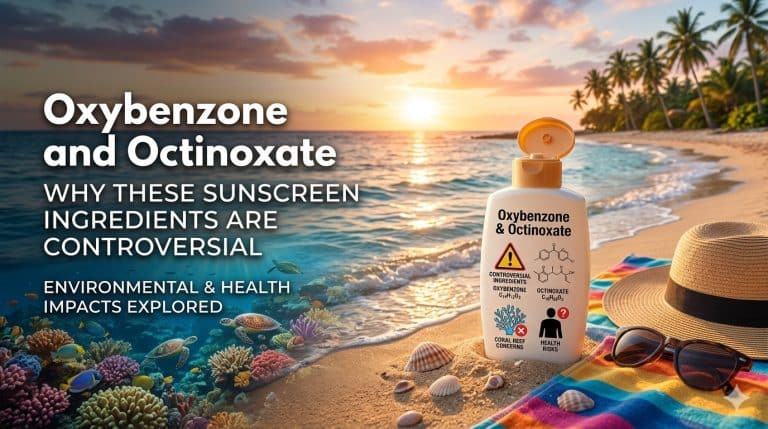
Oxybenzone, one of the most widely used chemical filter ingredients, has been linked to hormone disruption. Studies have detected it in breast milk, blood, and urine, raising questions about its long-term impact on the endocrine system.
Octinoxate is another ingredient that’s drawn scrutiny. Research has flagged it as a potential endocrine disruptor, and it’s been banned in several locations including Hawaii due to its harmful effects on coral reefs.
If you’re trying to make smarter choices about what goes on your skin, understanding which sunscreen ingredients to avoid is an essential starting point.
Why Mineral Sunscreen Is Considered Safer
The key advantage of mineral sunscreen comes down to minimal systemic absorption. Zinc oxide and titanium dioxide don’t penetrate beyond the skin’s surface in meaningful amounts, which means they’re not entering your bloodstream the way chemical filters do.
Both zinc oxide and titanium dioxide are classified by the FDA as Generally Recognized as Safe and Effective (GRASE). That’s a designation that no chemical sunscreen active ingredient currently holds.
Mineral sunscreen is particularly recommended for the following groups:
- Babies and young children
- Pregnant or breastfeeding women
- People with sensitive, reactive, or acne-prone skin
- Anyone concerned about hormone-disrupting ingredients
Zinc oxide also offers broad-spectrum protection on its own, covering both UVA and UVB rays. That makes it one of the most complete single-ingredient sun filters available.
It’s also worth noting that mineral sunscreens don’t generate heat when they interact with UV light. Chemical filters convert UV into heat energy, which can actually aggravate conditions like rosacea or melasma in some people.
Can Chemical Sunscreen Be Harmful Long-Term?
The honest answer is: we don’t fully know yet. The concern isn’t necessarily that using chemical sunscreen once or twice causes immediate harm — it’s the cumulative daily exposure over months and years.
Most adults apply sunscreen to large surface areas of the body regularly throughout the warmer months. That repeated exposure to potentially hormone-disrupting compounds is what has researchers concerned.
Children are especially vulnerable because their skin absorbs substances more readily, and their endocrine systems are still developing. Applying a sunscreen loaded with oxybenzone or octinoxate to a child daily during summer is something worth reconsidering.
There’s also the environmental angle. Chemical sunscreen ingredients have been shown to damage coral reefs and aquatic ecosystems, which has led to bans in places like Hawaii, Key West, and Palau.
Which Sunscreen Should You Choose?
If safety is your primary concern, mineral sunscreen is the clearer choice. The evidence supporting its safety profile is stronger, and the regulatory standing of its active ingredients is more favorable.
That said, the best sunscreen is ultimately the one you’ll actually use consistently. No SPF protection is better than skipped protection, so finding a mineral formula you enjoy wearing matters.
Look for sunscreens with zinc oxide as the primary active ingredient, ideally at a concentration between 15% and 25% for solid broad-spectrum coverage. Avoid formulas with nanoparticles if you have concerns about deeper skin penetration.
You can explore a curated range of non-toxic sunscreen options that use mineral-only filters and avoid the synthetic chemicals that have raised red flags.
Reading labels carefully is a habit worth building. If oxybenzone, octinoxate, homosalate, or octocrylene appear on the ingredients list, those are chemical filter sunscreens — and now you know what that means for your body.
The Bottom Line
Both types of sunscreen protect you from UV damage, but they do so in very different ways — and with very different safety profiles. Mineral sunscreen, backed by FDA recognition and a non-absorbing mechanism, offers a more reassuring option for everyday use.
Chemical sunscreens may feel more cosmetically elegant, but the growing body of evidence around systemic absorption and hormonal effects makes them a less ideal choice, especially for vulnerable populations. Making the switch to mineral-based protection is one of the simplest upgrades you can make for your skin health.
Sources
FDA.gov
EWG.org – Environmental Working Group Sunscreen Guide
NIH National Library of Medicine – Sunscreen Absorption Studies
American Academy of Dermatology – Sunscreen FAQs