Best Non-Toxic Sunscreen: What I Use After 10 Years in the Desert
This post may contain affiliate links. This means if you click on the link and purchase something, I will receive a commission with no extra cost to you. For more information, please read my disclaimer.
If you’ve been here a while, you’ll know I take sunscreen very seriously. I’m Irish, I lived in the desert for 10 years, and my friends jokingly call me the Queen of Sunscreen. I’m also so pale that people often stop me on holiday to remind me to reapply, and I used to find that amusing until I had a few experiences that made the warning feel very real.
One of the moments that stuck with me was being in the Maldives for my 40th birthday and seeing a ginger-haired Irish-looking man asleep in full sun with no hat, no umbrella, and no protection at all. I was genuinely worried for him. I’ve had similar reminders in places where the sun feels especially strong, and I’ve learned that once I feel that shift, I reapply immediately — even if it means layering sunscreen on top of sunscreen. It’s not the nicest feeling, but it’s a lot better than getting burnt.
Being Irish with Fitzpatrick Type 2 skin means I burn easily, so I’ve spent years figuring out which sunscreens actually protect well, feel good on skin, and are realistic enough to use every day.
And if you’re just starting to think about what’s actually in your sunscreen — welcome. It can feel overwhelming at first, but I promise it gets easier. You don’t have to overhaul everything at once. Start with what you’re already using, see how it stacks up, and go from there. That’s exactly how I did it.
Key Takeaway
- Mineral sunscreens using zinc oxide or titanium dioxide are the strongest non-toxic option — the FDA has only confirmed these two ingredients as GRASE (Generally Recognized As Safe and Effective)
- Broad-spectrum SPF 30 or higher is the best everyday baseline
- The best sunscreen is the one you’ll actually apply generously and reapply often — the perfect formula you never use is no formula at all
- Texture, scent, finish, and white cast matter just as much as ingredient quality
- A sunscreen can be clean and still not be the right one for your skin type — and that’s okay
How I Test Sunscreen
I don’t just test sunscreen for ingredient lists. I test it the way I actually use it: on my face, under makeup, in strong heat, while travelling, and on days when I need to reapply more than once.
I also pay attention to texture, scent, white cast, finish, and whether a formula starts to feel heavy or annoying after a few hours. Having lived in the desert and spent time in places like the Amazon, I know that sunscreen has to work in more than ideal conditions.
The real test is always the same: would I actually reach for it again?

White Cast Matters — But It’s Not the Whole Story
White cast is one of the biggest concerns with mineral sunscreen, and I want to be upfront that my perspective here is not universal. I’m very fair, and on my own rosacea-prone skin, zinc sunscreen can actually be a benefit because it helps make my skin look less red and flushed. So for me, a little white cast is sometimes welcome.
But I know that’s not everyone’s experience — and the white cast issue looks very different depending on your skin tone. I try to be honest about what I see on my own face without assuming it will look the same on everyone else. For deeper skin tones, tinted formulas or products with iron oxides are genuinely worth seeking out. More on that in the skin type section below.
For me, the real question is always whether a sunscreen feels flattering, wearable, and comfortable enough to use every single day. Because the best SPF is the one you actually put on.
What Does “Non-Toxic” Sunscreen Actually Mean?
The term gets used a lot in the clean beauty space, and honestly it can feel like marketing noise after a while. So let’s cut through it.
A non-toxic sunscreen is one that avoids synthetic chemical UV filters suspected of disrupting hormones, irritating skin, or accumulating in the body. These sunscreens rely on mineral-based UV filters instead — zinc oxide and titanium dioxide — both of which sit on top of the skin and physically deflect UV rays rather than absorbing them into the bloodstream.
It’s also worth knowing that “non-toxic” doesn’t just refer to the UV filters. The full ingredient list matters, including preservatives, fragrances, and emulsifiers. A sunscreen can have clean UV filters and still contain synthetic fragrance or parabens further down the label. I check the full list, not just the active ingredients — and I’ll show you exactly what to look for below.
Chemical vs. Mineral Sunscreens: What’s the Difference?
Chemical sunscreens use synthetic UV-absorbing compounds like oxybenzone, avobenzone, octinoxate, and homosalate. These ingredients absorb UV radiation and convert it into heat, which is then released from the skin.
The problem is that many of these filters don’t stay on the surface. In 2021, the FDA confirmed that several chemical sunscreen ingredients are absorbed into the bloodstream at levels that warrant further safety testing. Oxybenzone, in particular, has been detected in blood, urine, and breast milk — not just after one application, but weeks after the last use. That was enough for me to make the switch permanently.
Mineral sunscreens use zinc oxide and/or titanium dioxide. These sit on the skin’s surface and create a physical barrier. They’re far less likely to be absorbed systemically and are the only two sunscreen ingredients the FDA has confirmed as safe and effective.
The good news is that modern mineral formulations have come a long way. Many now use micronized zinc oxide that blends much more smoothly than older formulas, and tinted options have made mineral sunscreen significantly more wearable across a much wider range of skin tones than even five years ago.
Ingredients I Avoid — And Why
I know ingredient lists can feel like reading a foreign language at first. I’ve been there. But once you know the handful of things to look out for, it genuinely becomes second nature. These are the ones I always check for — and if I see them, I put the product back.
Oxybenzone — The first thing I look for on any label. It’s been detected in blood, urine, and breast milk after sunscreen use and is linked to hormone disruption. It’s in a surprising number of mainstream products, including ones marketed as “reef safe.” If you’ve been using a sunscreen with this in it — please don’t panic. Now you know, and that’s what matters. Progress, not perfection.
Octinoxate (Octyl methoxycinnamate) — Associated with thyroid hormone interference and detected in human breast milk. Also banned in Hawaii and several other regions due to coral reef damage. Worth avoiding even in everyday formulas.
Homosalate — Disrupts estrogen, androgen, and progesterone, and has been shown to enhance the absorption of pesticides through the skin. It’s also commonly used at concentrations the EWG considers unsafe. One of those ingredients that flies under the radar.
Octocrylene — This one concerns me specifically because it degrades into benzophenone over time — a substance classified as a possible human carcinogen. The fact that it breaks down inside the product itself is what makes it particularly worth avoiding.
Synthetic fragrance — Often a catch-all term for dozens of undisclosed chemicals, many of which are known irritants or allergens. I avoid it in anything I use on my face daily, and I’d encourage you to do the same. “Unscented” and “fragrance-free” are not the same thing — check for both.
Parabens — Preservatives with estrogen-mimicking properties. They’ve been found in breast cancer tissue. That’s enough for me.
Retinyl palmitate — A form of vitamin A that may accelerate the development of skin lesions when exposed to sunlight. The irony of an ingredient that increases sun damage being inside a sun protection product is really something.
Scanning labels takes practice but I promise it becomes quick. Many mainstream sunscreens contain several of these simultaneously — which is why I check every time, even for brands I’ve bought before, because formulas change.
Ingredients I Look For
The cleanest sunscreens keep their ingredient lists short and transparent. Here’s what I want to see:
Zinc oxide — The gold standard of mineral UV filters and the one I trust most. Broad-spectrum protection against both UVA and UVB rays, gentle on sensitive skin, and genuinely helpful for rosacea-prone skin like mine. If zinc oxide is first on the active ingredients list, that’s a good sign.
Titanium dioxide — The other FDA-approved mineral filter. Effective primarily against UVB rays and short-wave UVA rays. Works well in combination with zinc oxide for fuller coverage.
Non-nano particles — Look for non-nano versions of both mineral filters where possible. A study testing zinc oxide nanoparticles found less than 0.01% entering the bloodstream after five days of twice-daily application — a reassuringly small number — but I still prefer non-nano when I have the choice.
Plant-based oils and butters — Jojoba oil, shea butter, sunflower seed oil. These nourish the skin without endocrine-disrupting properties and make mineral formulas feel more comfortable and less chalky to wear.
Tocopherol (vitamin E) — A clean antioxidant that helps protect against free radical damage. A lovely supporting ingredient in any formula.
Fragrance-free or lightly scented with essential oils — My preference for anything going on my face daily. Short ingredient list, recognizable names — that’s what I’m looking for.
My Sunscreen Reviews
I’m currently working through more options and will keep adding to this as I test. These are the three I can recommend without hesitation right now — the ones I’ve actually finished, or am close to finishing, which in the sunscreen world is the highest compliment I can give.*
Best Overall — Vacation Shake Shake SPF 50
| SPF | 50 |
| Texture | light, comfortable |
| Finish | Natural |
| Scent | The smell of sunshine |
| White cast | Minimal |
| My verdict | My desert island sunscreen. Would buy again without hesitation — and have. |
This is my all-time favorite and I genuinely don’t think anything is going to knock it off the top spot. The zinc coverage is excellent, it feels beautiful on skin, and the smell — that coconut smell — is my idea of what sun and happiness smell like in a bottle. I know that might sound dramatic, but if you’ve tried it, you’ll understand.
I’ve tested a lot of sunscreens and the question I always come back to is: would I actually buy this again? With Vacation Shake Shake, the answer is absolutely yes. And I have. Multiple times. Which is more than I can say for most beauty products — we all have the ones that sit three-quarters full at the back of the bathroom cabinet until we finally throw them out. Shake Shake I use until the very last drop, which in this house is saying something.
My one issue is the packaging. The bottle is easy to spill even though the formula itself is thick — a small design flaw that doesn’t match the quality of what’s inside. I also tried their roll-on version, the body one, and it doesn’t contain zinc. It’s not bad and the roll-on application is genuinely convenient, but the formula is more fluid and noticeably different from the original. For me the cream version is the one worth buying every time.
Mineral Milk Face Sunscreen, Non-Comedogenic, Streak-Free, Water-Resistant Broad Spectrum Sun Block, Non-Nano Zinc Formula, Vegan, Moisturizer with SPF, 1.7 Fl. Oz.

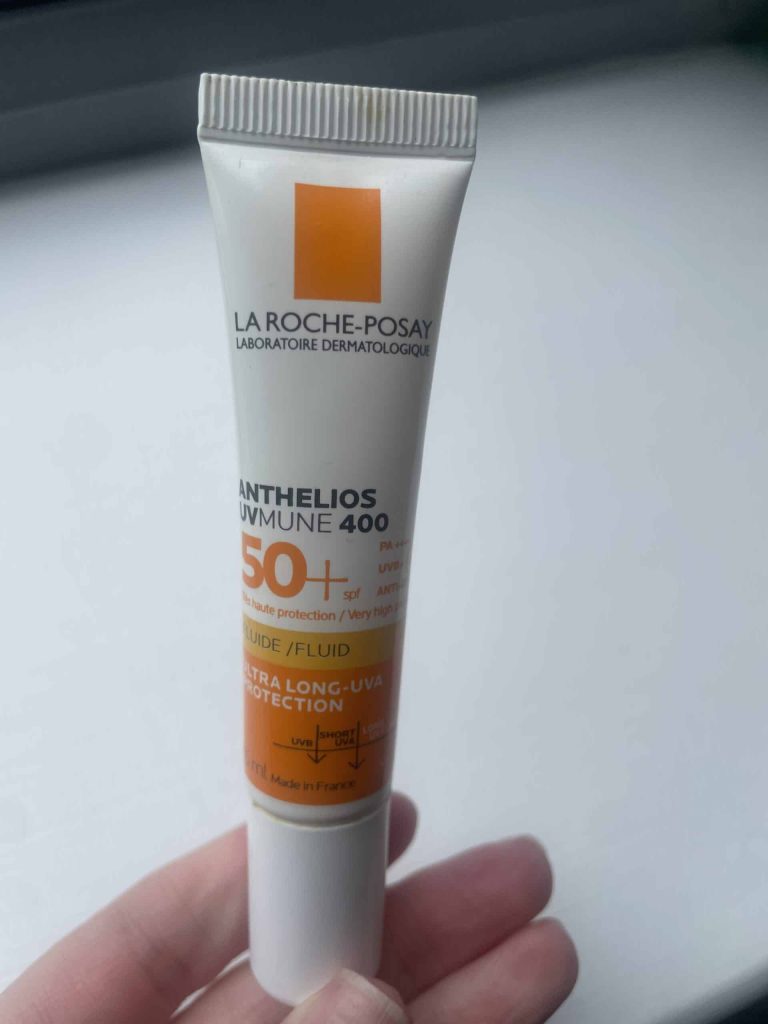
Best Everyday Handbag Option — La Roche-Posay Anthelios SPF 50+
| SPF | 50+ |
| Texture | Fluid — store upside down |
| Finish | Clean |
| Portability | Excellent — slim enough for any bag |
| My verdict | My handbag sunscreen. SPF 50+ in a package that goes everywhere. Just remember to store it upside down. |
This one has come a long way and I’ll date myself here — the earlier Anthelios tinted version had a smell and a pigment that were both off, and I abandoned it pretty quickly. The current formula is a completely different product and I’m genuinely impressed.
What I love: it’s SPF 50+ which I always prefer for the face, and the packaging is narrow and slim enough to fit in almost anything. It slides perfectly into my Longchamp travel bag — the one my sister gifted me for Christmas and quite possibly the best travel bag I’ve ever owned, particularly relevant if you’re navigating the Ryanair rule about fitting under the seat in front of you. For very pale skin or for anyone heading somewhere with intense sun who doesn’t want to be caught out, this is the one I’d slip into a handbag without thinking twice.